

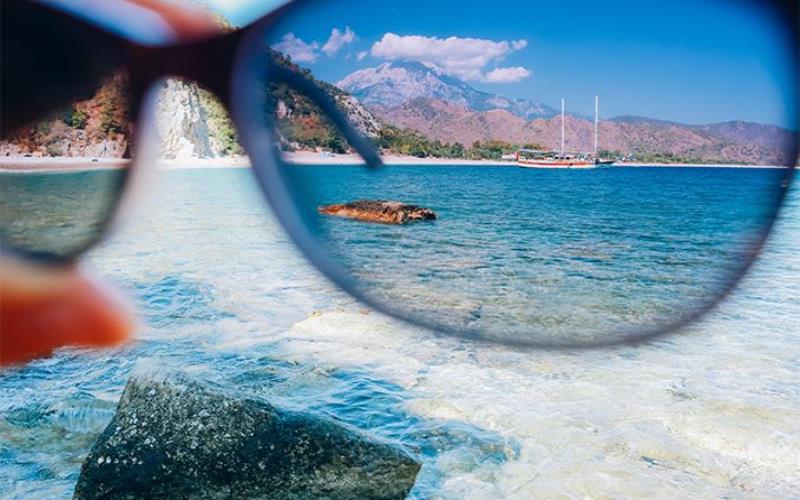
Sunglasses with polarized lenses have become very fashionable basically because, in addition to protecting our eyes from ultraviolet radiation from the sun , this type of glasses manage to eliminate a large part of the annoying reflections or glare that occur under certain lighting conditions.
If you want to know in depth what polarized lenses are, how they work and what their benefits are, take note because in this article we will tell you everything.
How do polarized crystals work?
To understand the special and advantageous characteristics of polarized lenses, we must be very clear about the behavior of sunlight when it bounces off a horizontal surface.
Normally, when light bounces off a horizontal surface, it becomes partially polarized until it becomes a bright and very annoying light, which is popularly known as reflections.
Well, the lenses of polarized glasses are able to filter these reflections and, therefore, avoid the glare they produce and other discomforts.
What are the advantages of polarized lenses?
Polarized glasses can be made both neutral and prescription for those who require it, and even progressive glasses. This is possible because the polarized filter of the lens is achieved by adding a very thin film to the standard glass.
Another advantage is that polarized glasses do not darken as much in dim or low-light situations, which allows us to continue to have good vision in these conditions. For example, when we are driving in bright sunlight and suddenly enter a tunnel.
- They help reduce eye fatigue.
- The perception of colors is more natural.
- They are light and resistant crystals that provide more comfort and safety.
- They are especially recommended for people who suffer from photophobia or are sensitive to light.
What are they used for?
Polarized glasses are ideal for protecting against sunlight in situations where the sun bounces off horizontal surfaces, which is when reflections and glare appear.
Therefore, the following are preferably used:
- To improve vision and concentration while driving.
- To practice water sports or water-related activities, such as fishing.
- For skiing and other winter sports.
- For practicing other outdoor sports, such as golf, cycling, hiking or running.
What are its disadvantages?
Although the use of polarized glasses is usually very satisfactory for most people, there are also some disadvantages and limitations of this type of lenses:
Polarized lenses are designed to reduce reflections that occur on horizontal surfaces, therefore, if the glare is very strong or vertical (for example the reflection of the sun’s rays bouncing off the glass of a building) it is possible that polarized glasses will not be able to offer total protection and some reflections may filter through to the user’s eyes.
Some users have reported poor viewing of LCD screens on their computer, car navigation system, tablet or smartphone through these glasses. The main complaint is that these images come out distorted and darker. This is because these screens use polarized light to create the images.
Some of the reflections filtered by polarized lenses, which the wearer therefore cannot see, could provide useful information that the wearer misses. A typical example would be ice patches on the snow, which are more difficult to detect with polarized glasses and can be dangerous for the skier or driver.
The user does not have as wide a range of products to choose from as there are other options. Not all types of glasses or all prescriptions are available in polarized versions.
How to recognize polarized lenses?
The polarized filter is not found by default in all sunglasses lenses. We can check whether lenses are polarized or not in two ways:
Polarized glasses usually have the P mark on the lens or Polarized on the temple. This indication may also appear on the product label.
If we do not find this distinctive mark, but we suspect that the sunglasses may have polarized lenses, we can place them in front of an LCD screen. If the lenses are polarized, when we turn the glasses and look through them at certain angles, we will be able to see that the screen becomes lighter and darker.