

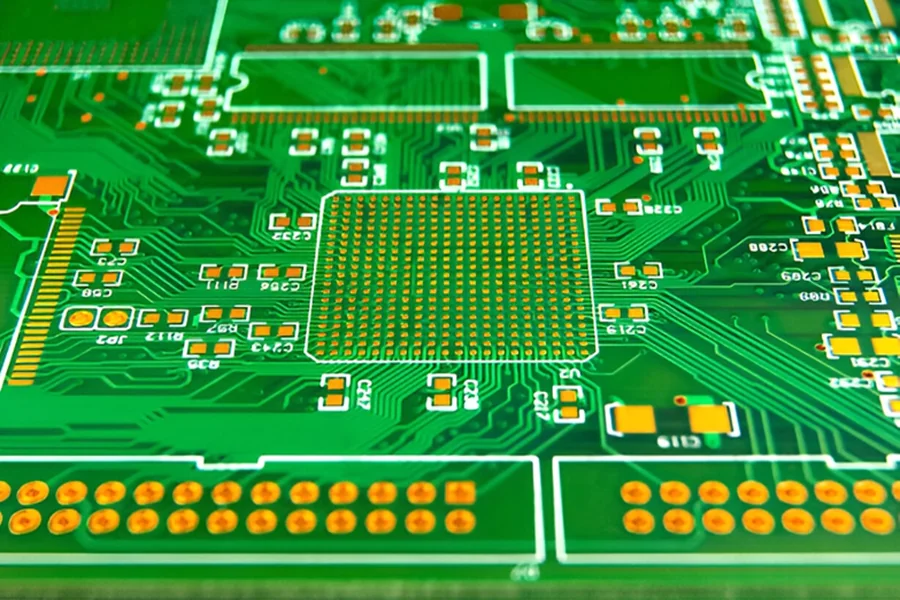
A BGA PCB board (Ball Grid Array Printed Circuit Board) is a highly advanced PCB design used for mounting integrated circuits (ICs) that require high density, high performance, and reliable electrical connections. Instead of traditional pins or leads, BGA packages use tiny solder balls arranged in a grid pattern on the underside of the component. These solder balls connect directly to matching pads on the PCB, enabling a compact layout with excellent signal integrity.
BGA technology is widely used in modern electronics such as smartphones, laptops, networking devices, medical equipment, and automotive control units because it offers better thermal performance, increased pin count capability, and improved electrical efficiency compared to older packaging methods.
Structure of a BGA PCB Board
A BGA PCB board has a unique structure that allows for high-density interconnections without compromising performance:
- BGA Package – The integrated circuit enclosed in a protective housing with solder balls on its underside.
- Solder Balls – Tiny spheres of solder that create electrical and mechanical connections to the PCB pads.
- PCB Pads – Precisely aligned copper pads on the board that match the solder ball arrangement.
- Multi-Layer PCB Stack-Up – Often includes multiple layers for routing high-speed signals and power connections.
Many BGA PCB boards also integrate microvias, blind vias, and buried vias to achieve efficient signal routing within a compact design.
Advantages of BGA PCB Board
BGA PCB boards are preferred in modern electronics for several reasons:
- High-Density Connections – Supports more I/O connections without increasing board size.
- Improved Electrical Performance – Shorter connection paths reduce signal delay and interference.
- Better Heat Dissipation – The large contact area between solder balls and PCB pads improves thermal transfer.
- Strong Mechanical Reliability – Reduced risk of bent or broken leads compared to traditional packages.
- Space-Saving Design – Ideal for portable devices where compactness is essential.
Applications of BGA PCB Board
Because of their performance and space efficiency, BGA PCB boards are used in many industries:
- Consumer Electronics – Smartphones, tablets, gaming consoles, and laptops.
- Networking Equipment – Routers, switches, and telecommunication devices.
- Medical Electronics – Diagnostic equipment, patient monitoring devices, and imaging systems.
- Automotive Systems – Engine control units, infotainment systems, and safety electronics.
- Industrial Automation – High-speed control systems and robotics.
Thermal and Electrical Performance of BGA PCB Board
Thermal management is a critical factor in BGA PCB board design. The direct contact between the solder balls and PCB pads allows for efficient heat dissipation from the IC to the board. In addition, because the connections are shorter, electrical resistance is minimized, resulting in faster signal transmission and reduced power loss.
In high-speed applications, BGA boards often incorporate controlled impedance routing, differential pairs, and advanced materials to ensure signal integrity.
Manufacturing Process of BGA PCB Board
The production of a BGA PCB board involves precision engineering:
- PCB Fabrication – Creating the board with high-accuracy drilling, copper plating, and layer stacking.
- Pad Layout Design – Aligning pad patterns to match the BGA solder ball arrangement.
- Solder Paste Application – Applying paste to pads using a stencil.
- BGA Component Placement – Positioning the BGA package with pick-and-place machines.
- Reflow Soldering – Heating the assembly to melt solder balls, forming secure electrical connections.
- Inspection and Testing – Using X-ray inspection to detect hidden defects beneath the BGA package.
Design Considerations for BGA PCB Board
Designing a BGA PCB board requires careful planning:
- Pad Size and Shape – Must match the solder ball dimensions to ensure reliable bonding.
- Via Placement – Microvias or via-in-pad designs are often used for signal escape routing.
- Thermal Vias – Help transfer heat away from the component.
- Layer Count – More layers may be needed for complex routing and power distribution.
- Solder Mask Definition – Can be non-solder mask defined (NSMD) or solder mask defined (SMD) depending on design needs.
Challenges in BGA PCB Board Assembly
BGA assembly is more complex than traditional PCB assembly due to the hidden nature of solder joints beneath the package. Inspection requires advanced equipment like X-ray machines, and rework can be challenging if a joint fails. Proper reflow temperature control and precise alignment are critical for preventing defects such as solder bridging, cold joints, or voids.
Future of BGA PCB Board Technology
With the increasing demand for smaller, faster, and more powerful electronics, BGA PCB board technology will continue to evolve. Emerging trends include finer pitch BGAs, stacked BGA packages, and integration with advanced substrate materials for 5G, AI, and IoT applications. As designs push the limits of miniaturization, manufacturing capabilities will need to adapt with even greater precision and automation.
Choosing the Right BGA PCB Board Manufacturer
To get the best results, it’s important to work with a skilled bga pcb board manufacturer who understands the complexities of high-density interconnect (HDI) design, precise assembly, and advanced inspection techniques. A trusted bga pcb board manufacturer can provide custom solutions, ensure high yield rates, and deliver products that meet both performance and reliability standards. By partnering with the right bga pcb board manufacturer, you can confidently bring your high-performance electronic products to market with the assurance of quality and durability.